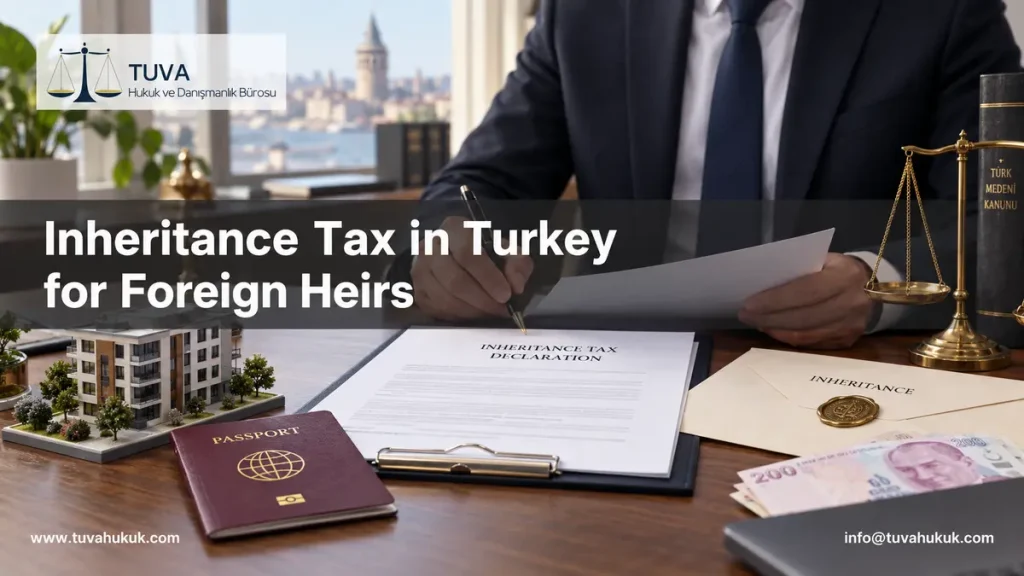
Foreign nationals who inherit assets located in Turkey may be required to file a Turkish inheritance tax return and pay Inheritance and Transfer Tax (Veraset ve İntikal Vergisi). This obligation may apply even if the heir lives abroad, has never resided in Turkey and does not hold Turkish citizenship.
The tax procedure can cover inherited apartments, land, money held in Turkish bank accounts, company shares, vehicles and other assets situated in Turkey. The applicable filing deadline depends on where the death occurred and where the heir was living at the relevant time. The value and type of each asset, the heir’s relationship to the deceased and available statutory exemptions affect the amount payable.
This guide explains how inheritance tax in Turkey applies to foreign heirs, the rates and exemptions applicable in 2026, filing deadlines, required documents and how the process may be completed from abroad.
Turkish Inheritance Tax for Foreign Heirs at a Glance
- Foreign heirs may be liable for Turkish inheritance tax on assets located in Turkey even if they live abroad and have never held Turkish citizenship.
- Inheritance tax rates for 2026 range progressively from 1% to 10%.
- The 2026 exemption is TRY 2,907,136 for each child, adopted child and surviving spouse. If the surviving spouse is the sole heir because there are no descendants, the exemption is TRY 5,817,845.
- An inheritance tax return generally must still be filed even where the inherited share remains below the applicable exemption.
- The filing period may be four, six or eight months depending on where the death occurred and where the heir was living.
- Assessed inheritance tax is generally paid in six equal instalments over three years, in May and November.
- Depending on the documents and the heir’s circumstances, the procedure may often be coordinated through a lawyer without the heir travelling to Turkey.
Foreign heirs who require coordinated assistance with the court, tax, banking and property stages can review our Turkish inheritance law services.
Does Turkey Have an Inheritance Tax?
Yes. Assets transferred through inheritance or another gratuitous transfer may be subject to Turkish Inheritance and Transfer Tax under Inheritance and Transfer Tax Law No. 7338.
Two types of acquisition fall within the general scope of the law:
- Inheritance: Assets transferred following a person’s death, either under statutory inheritance rules or a valid testamentary disposition.
- Gratuitous transfers: Gifts, donations and other transfers made without consideration during a person’s lifetime.
Although both are governed by the same tax legislation, different tax rates apply. In 2026, inheritance rates range from 1% to 10%, while the rates applicable to gratuitous transfers generally range from 10% to 30%.
Inheritance tax should be distinguished from the rules determining who qualifies as an heir. The identity and shares of the heirs may require a separate assessment under Turkish inheritance law and, in cross-border cases, Turkish private international law. For a broader explanation, see inheritance rights of foreigners in Turkey.
Do Foreign Heirs Pay Inheritance Tax in Turkey?
Foreign heirs may be liable for Turkish inheritance tax when they receive assets located in Turkey. Living outside Turkey does not, by itself, remove the obligation to declare an inherited Turkish asset.
The official guidance published by the Turkish Revenue Administration states that the tax covers assets belonging to Turkish citizens and assets located in Turkey that pass by inheritance or another gratuitous transfer. For a foreign national with no other connection to Turkey, the principal concern will therefore generally be the assets situated in Turkey, such as property, a Turkish bank balance or shares in a Turkish company.
The scope should still be examined in light of the nationality and residence of the deceased and heir, the location and legal nature of each asset, and whether the same asset is taxed in another country. The existence of a filing obligation does not necessarily mean that tax will ultimately be payable.
Which Inherited Assets May Be Taxable in Turkey?
Common examples include:
- Houses, apartments, land and commercial property
- Money and foreign currency held in Turkish bank accounts
- Shares in Turkish limited or joint-stock companies
- Securities and investment accounts
- Motor vehicles
- Receivables and contractual rights
- Business assets and other registered movable assets
Identifying the type and location of each asset is important because different documents and valuation rules may apply. Obtaining a certificate of inheritance does not automatically complete the tax, bank, company or land registry procedures.
Inheritance Tax on Property in Turkey
A foreign national who inherits an apartment, house, land or commercial property in Turkey may need to declare the property before completing the relevant land registry transactions.
The tax valuation is not necessarily the property’s advertised or open-market price. The declaration commonly requires documentation showing its value for property tax purposes, obtained from the relevant municipality.
The process may involve:
- Identifying the property and examining the current title record.
- Obtaining a certificate of inheritance recognised in Turkey.
- Obtaining Turkish tax identification numbers for the foreign heirs.
- Obtaining the municipality’s property tax value document.
- Filing the inheritance tax return.
- Completing succession registration at the land registry.
- Resolving the tax position before a later sale, transfer or mortgage.
Succession registration and a later disposal of the property are separate transactions. Registration in the heirs’ names may generally be completed before all scheduled inheritance tax instalments have been paid. However, a subsequent sale, transfer, mortgage or establishment of certain real rights will normally require tax clearance. Depending on the applicable rules and the intended transaction, the outstanding tax may need to be paid or acceptable security may need to be provided.
Foreign ownership restrictions are separate from the inheritance tax assessment. For a broader explanation of the title deed and succession procedure, see inheriting property in Turkey as a foreign national.
Inheritance Tax on Money Held in a Turkish Bank Account
Money held in a Turkish bank account may form part of the taxable estate. The bank will ordinarily require evidence identifying the heirs and their shares before releasing the deceased’s funds.
Documents may include a Turkish certificate of inheritance, passports and tax numbers, the death certificate, certified Turkish translations, inheritance tax documents and a compliant power of attorney.
Article 17 of Law No. 7338 contains safeguards for money and securities held by banks and other institutions. Where the required tax clearance certificate is not presented, a statutory withholding mechanism may apply. In an inheritance case, the institution may withhold 5% as security for the tax before releasing the balance, subject to the applicable requirements.
This withholding is not necessarily the final inheritance tax. The actual liability is calculated through the tax return using the relevant valuation, deductions, exemptions and progressive tariff.
Inheritance Tax on Shares in a Turkish Company
Shares held by the deceased in a Turkish company may pass to foreign heirs and form part of the inheritance tax declaration. The procedure depends partly on the company type, articles of association, form of the shares, financial statements, ownership percentage and number of heirs.
The value of company shares should not automatically be treated as their nominal value or an informal sale estimate. The Revenue Administration may require commercial balance sheets, income statements, operating-account summaries, trade registry records or share certificates.
The applicable valuation method may differ depending on whether the shares are listed and have recently been traded, whether they are unlisted and whether they form part of a commercial enterprise. The appropriate value should therefore be determined under the statutory valuation rules and supported by the company’s financial and corporate records, rather than being based solely on the nominal value or an informal sale estimate.
The tax filing and corporate transfer are separate. Filing the return does not by itself update the company’s share ledger or complete any necessary trade registry or corporate approvals.
How Is Inheritance Tax Calculated in Turkey?
Inheritance tax is generally calculated separately by reference to each heir’s share, rather than by applying one percentage to the gross estate.
The calculation normally involves:
- Determining the assets passing to the heir.
- Establishing their values under the applicable rules.
- Examining deductible estate debts and documented expenses.
- Applying any statutory exemption available to the heir.
- Applying the progressive tariff to the remaining taxable amount.
Entering a higher bracket does not mean that the highest rate applies to the whole amount. Each portion is taxed at the rate for its bracket.
Turkish Inheritance Tax Rates for 2026
| Taxable amount | Inheritance rate | Gratuitous-transfer rate |
| First TRY 3,000,000 | 1% | 10% |
| Next TRY 7,000,000 | 3% | 15% |
| Next TRY 15,000,000 | 5% | 20% |
| Next TRY 30,000,000 | 7% | 25% |
| Amount exceeding TRY 55,000,000 | 10% | 30% |
These are progressive brackets. Where the taxable inheritance exceeds TRY 3,000,000, the first TRY 3,000,000 remains subject to 1% and only the next portion enters the 3% bracket.
The figures are based on the Turkish Revenue Administration’s official 2026 Inheritance and Transfer Tax guidance. The applicable figures must be determined according to the date of the taxable transfer.
Inheritance Tax Exemptions in Turkey for 2026
For inheritances occurring in 2026, the following exemptions apply to qualifying descendants, including adopted children, and the surviving spouse:
- TRY 2,907,136 of the inheritance share received by each child or surviving spouse
- TRY 5,817,845 of the surviving spouse’s share where there are no descendants and the spouse is the sole heir
The exemption is considered separately for each qualifying heir. Different rules may apply to other relatives, appointed heirs, will beneficiaries and lifetime gifts.
An inheritance remaining below an exemption may still have to be declared. The Revenue Administration states that an inheritance tax return is generally required for inherited assets even where their value remains below the inheritance exemption.
Example: Calculating Inheritance Tax for Foreign Heirs
Assume a deceased person leaves a Turkish property valued for tax purposes at TRY 15,000,000 to two children in equal shares, with no deductible debts or expenses.
Each child receives TRY 7,500,000. After deducting the 2026 exemption of TRY 2,907,136, each child’s taxable inheritance is TRY 4,592,864.
- First TRY 3,000,000 at 1%: TRY 30,000
- Remaining TRY 1,592,864 at 3%: TRY 47,785.92
- Illustrative tax for each child: TRY 77,785.92
- Combined illustrative tax: TRY 155,571.84
This is a simplified example. The actual calculation may change because of valuation rules, debts, expenses, other assets, the heirs’ status and the date of death.
When Must a Foreign Heir File the Return?
| Place of death | Heir’s place of residence | General filing period |
| Turkey | Turkey | Four months |
| Turkey | A foreign country | Six months |
| A foreign country | Turkey | Six months |
| A foreign country | The same foreign country | Four months |
| A foreign country | A different foreign country | Eight months |
The period generally runs from the date of death. A separate one-month period applies after registration of a judicial declaration of absence in the death register.
The distinction between the country of death and the heir’s country of residence is important. It is incorrect to assume that every heir living abroad automatically receives six months. Foreign heirs should begin collecting apostilled or legalised civil-status records and certified Turkish translations promptly.
Which Tax Office Is Responsible?
The return is generally submitted to the tax office for the deceased’s place of residence. Where the deceased resided abroad, the competent office may be determined by the deceased’s last place of residence in Turkey. If no Turkish residence can be established, the appropriate office should be confirmed with the Revenue Administration.
The official Inheritance and Transfer Tax Declaration Application is accessible through Turkey’s e-Government portal. Foreign heirs without Turkish digital credentials or with foreign-issued records may still need direct representation.
Documents Required for the Inheritance Tax Return
Depending on the estate, the documents may include:
- Certificate of inheritance
- Document showing the deceased’s last registered residence
- Will or inheritance agreement, if applicable
- Documents concerning estate debts and expenses
- Commercial balance sheet, income statement or operating-account summary
- Trade registry records showing the ownership structure
- Municipality document showing the property tax value
- Registration documents for vehicles and other registered assets
- Bank letters showing balances or receivables
- Share certificates or documents relating to company shares
- Passports and Turkish tax identification numbers
- Foreign death and civil-status records
- Apostille or consular legalisation and certified Turkish translations
- A properly drafted power of attorney
Name, surname and date-of-birth discrepancies should be identified before filing. For more information, see how to obtain a certificate of inheritance in Turkey.
How and When Is Turkish Inheritance Tax Paid?
Once assessed, inheritance tax may generally be paid in six equal instalments over three years, with payments in May and November.
The filing deadline and payment schedule are different. The three-year instalment plan does not extend the period for filing the return. An heir planning to sell inherited property should also consider that the tax attributable to the property may need to be settled before the sale.
Can Property Be Registered Before All Instalments Are Paid?
Yes, succession registration in the heirs’ names may generally be completed before all scheduled inheritance tax instalments have been paid. The registration of inheritance should be distinguished from a subsequent sale or other disposal of the property.
Before a later sale, transfer, mortgage or establishment of certain real rights, the tax attributable to the property will normally need to be paid. In cases permitted by the applicable legislation, the competent tax authority may allow the relevant clearance against acceptable security. The documents and tax status should therefore be confirmed with the competent tax office and land registry before the intended transaction.
Can a Turkish Bank Release Funds Before the Tax Procedure Is Completed?
Banks will normally request documents establishing the heirs’ entitlement and addressing inheritance tax. Where a tax clearance certificate is unavailable, Article 17 provides a withholding mechanism, including 5% withholding from inherited money or securities in qualifying circumstances.
Whether the balance can be released also depends on the certificate of inheritance, number of heirs, power of attorney, bank compliance checks and restrictions affecting international transfers. Bank withholding does not replace the inheritance tax return.
What Happens If the Return Is Filed Late?
A late or missing declaration may cause penalties, late-payment consequences and delays in accessing or transferring assets. The result depends on the duration of the delay, whether the heir files voluntarily, whether tax is payable and whether an official examination has begun.
Foreign heirs should not simply wait because apostille, translation or foreign probate procedures are taking longer than expected. Available procedural options should be assessed before the filing period expires.
Is Inheritance Tax Paid Abroad Deductible in Turkey?
The payment of inheritance or estate tax in another country does not automatically eliminate or reduce the Turkish inheritance tax liability. Turkish legislation does not provide a universal foreign-tax credit for every cross-border inheritance.
Any deduction or relief must be examined according to the nationality and residence of the deceased and the heir, the location of the relevant asset, the scope of Article 12 of Inheritance and Transfer Tax Law No. 7338, documentary evidence of the foreign tax payment and any specifically applicable international agreement.
General double-taxation agreements should not automatically be assumed to cover inheritance or estate taxes. The heir’s Turkish filing obligations and the tax treatment in the country of residence should therefore be reviewed together. Foreign heirs should not deduct overseas taxes from a Turkish inheritance tax declaration without obtaining a case-specific assessment.
Can Foreign Heirs Complete the Procedure Without Travelling to Turkey?
Many court, tax, bank, company and land registry procedures may be completed through a Turkish lawyer acting under an appropriately drafted power of attorney.
The power of attorney may be issued at a Turkish consulate, before a foreign notary followed by apostille, through consular legalisation where apostille is unavailable, or before a Turkish notary.
Depending on the estate, it may need to authorise the lawyer to obtain a certificate of inheritance and tax numbers, file tax returns, communicate with tax offices, conduct land registry and bank transactions, complete company procedures, receive notifications and conduct litigation.
Authority to obtain a certificate of inheritance does not automatically include authority to sell property, withdraw money or transfer company shares. Anticipated transactions should be expressly covered.
Step-by-Step Process for a Foreign Heir
- Identify the Turkish assets. Determine whether the estate contains property, bank accounts, company shares, vehicles or other rights.
- Collect the foreign documents. Obtain the death certificate and records establishing the family relationship.
- Complete authentication and translation. Arrange apostille or legalisation and certified Turkish translations.
- Obtain Turkish tax identification numbers. Foreign heirs may need tax numbers before filing and transfer procedures.
- Obtain a Turkish certificate of inheritance. Foreign civil-status records commonly require an application to the Civil Court of Peace.
- Determine the filing deadline. Identify the country of death and residence of each heir.
- Value the assets. Obtain municipality, bank, company and other official records.
- File the inheritance tax return. Declare the assets, debts, expenses and inheritance shares.
- Obtain the necessary tax documentation. Address assessment, payment, withholding or clearance requirements.
- Complete the asset-specific transfer. Register the property, release bank funds or complete company-share procedures.
Common Mistakes Made by Foreign Heirs
- Assuming that a foreign probate document is automatically sufficient in Turkey
- Missing the filing deadline while waiting for foreign documents
- Using tax brackets from an earlier year
- Treating the market price as the automatic tax value of a property
- Failing to identify all Turkish bank accounts or company interests
- Filing without documents supporting estate debts and expenses
- Confusing the certificate of inheritance with the tax declaration
- Assuming instalment payments permit an immediate property sale
- Treating bank withholding as the final tax calculation
- Using documents without apostille, legalisation or certified translation
- Issuing a power of attorney without the necessary express powers
- Acting on estate assets without investigating the deceased’s debts
How Tuva Law Can Assist Foreign Heirs
A foreign inheritance may require coordination between a Turkish court, tax office, municipality, land registry, bank, company and trade registry. The procedure becomes more complex where the heirs live abroad and the documents were issued in another country.
Tuva Law can assist with preliminary assessment, certificates of inheritance, Turkish tax numbers, tax declarations, tax-office coordination, registration of inherited property, release of bank funds, transfer of company shares, powers of attorney and representation of heirs living abroad.
If you inherited property, a Turkish bank account or company shares and want the procedure handled without travelling to Turkey, you may contact Tuva Law.
When contacting us, please include the deceased’s nationality, country and date of death, your nationality and country of residence, your relationship to the deceased, the type and location of the assets, whether a will exists and whether a certificate of inheritance has been obtained.
Frequently Asked Questions
Do foreigners pay inheritance tax in Turkey?
Foreign nationals may be required to pay Turkish inheritance tax when they inherit assets located in Turkey. This can apply even if the heir lives abroad and has never resided in Turkey. The final liability depends on the assets, their values, available exemptions and the heir’s status.
What is the inheritance tax rate in Turkey?
For inheritances occurring in 2026, progressive rates range from 1% to 10%. The tariff is applied after relevant deductions and exemptions. Gifts and other lifetime gratuitous transfers use a separate, higher tariff.
How much can a child or spouse inherit tax-free in 2026?
In 2026, TRY 2,907,136 of the share received by each qualifying child or surviving spouse is exempt. Where there are no descendants and the spouse is the sole heir, the exemption is TRY 5,817,845.
Is inheritance tax calculated on the whole estate?
The tax is generally calculated separately according to the share received by each heir. Applicable deductions and exemptions are considered before the progressive tariff is applied.
Must a return be filed if no tax is payable?
Generally, yes. The Revenue Administration states that inherited assets must be declared even when the inheritance remains below the applicable exemption.
Is money inherited from a Turkish bank account taxable?
Money held in a Turkish bank account may form part of the taxable estate. The bank generally requires a certificate of inheritance, identification and tax documentation before releasing funds or applying statutory withholding.
Are inherited company shares taxable in Turkey?
Shares in a Turkish company may be included in the declaration. Their valuation and transfer depend on the company type, financial records, share structure and applicable tax and corporate requirements.
How long does a foreign heir have to file the return?
The period may be four, six or eight months depending on where the death occurred and where the heir resided. An heir living in a different foreign country from the country of death generally has eight months.
Can the tax be paid in instalments?
Yes. Assessed inheritance tax is generally payable in six equal instalments over three years, in May and November.
Can inherited property be registered before all instalments are paid?
Succession registration may be possible while future instalments remain outstanding, but the tax attributable to the property generally must be fully paid before a later sale, transfer or establishment of certain rights.
What happens if the return is filed late?
Late filing may result in penalties, late-payment consequences and delays in property, bank or company procedures. The exact result depends on the circumstances and timing.
Does a foreign probate document replace a Turkish certificate of inheritance?
Not necessarily. It may be relevant evidence, but Turkish authorities may require a Turkish certificate, particularly for registered assets located in Turkey.
Can the procedure be completed through a lawyer?
Many stages can be completed through a Turkish lawyer holding a properly drafted power of attorney covering the relevant court, tax, bank, land registry and company procedures.
Do I need to travel to Turkey to claim my inheritance?
Not always. A foreign heir can often issue a power of attorney through a Turkish consulate or a foreign notary followed by apostille or legalisation. Personal attendance depends on the asset, institution and transaction.
Legal Review
This article has been prepared for general informational purposes and does not constitute tax advice, legal advice or a legal opinion concerning a particular estate. Liability, valuation, deductions, filing deadlines and document requirements must be assessed according to the date of death, assets and circumstances of the deceased and heirs.
Reviewer: Av. Osman Selçuk Akyüz
Position: Founding Attorney – Ankara Bar Association
Last reviewed: 10 September 2026