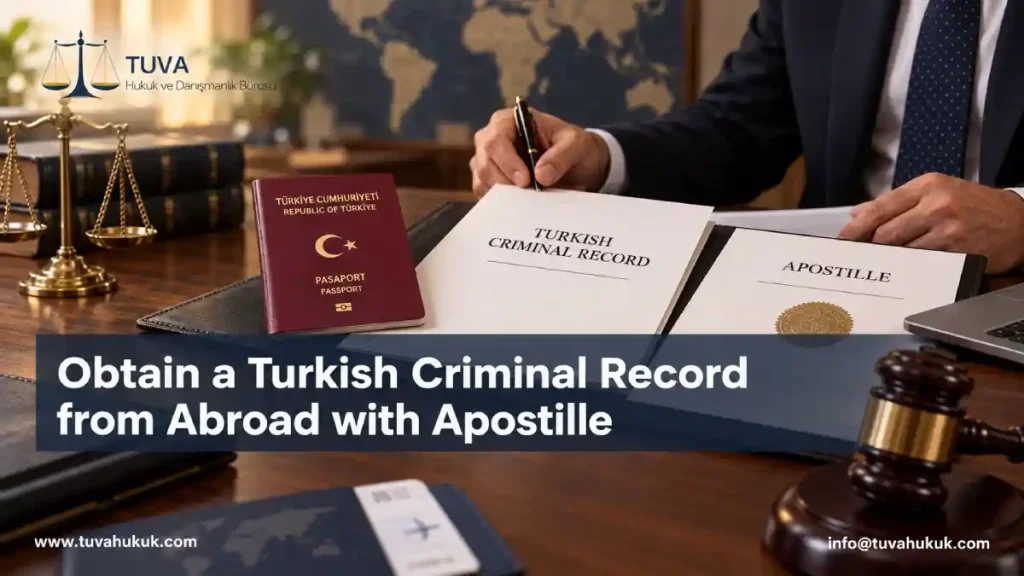
Need a Turkish police clearance certificate obtained, apostilled and delivered to you abroad? Tuva Law and Consultancy assists with obtaining your Turkish criminal record certificate (Adli Sicil Belgesi) and arranging the apostille or consular legalisation, translation and international delivery required for your application.
We assist Turkish citizens living abroad and foreign nationals who previously lived, worked or studied in Türkiye. Through a suitable Power of Attorney, we can handle the applicable procedures in Türkiye without you travelling here. We provide the Power of Attorney wording and explain how to arrange it in the country where you will sign.
From certificate retrieval to delivery, we coordinate the agreed steps and provide a clear explanation of the service scope, estimated timeframe and costs before work begins.
Request a Turkish Police Clearance Certificate
Tell Us What You Need
Send us a WhatsApp message with:
- Power of Attorney country: where you will sign;
- Country of use: where the certificate will be submitted;
- Document requirements: the requesting authority’s instructions, if available, or why you need the certificate; and
- Deadline: when you need the completed documents.
We will review these details and explain how we can handle your request, what you need to provide, the estimated timeframe and the professional fee, together with any additional certification, translation or delivery expenses.
Contact us before signing your Power of Attorney so we can provide instructions appropriate to your country and the required procedure.
Also need a full Turkish civil registry extract (Tam Tekmil Vukuatlı Nüfus Kayıt Örneği)? We also assist eligible Turkish citizens with obtaining this document and arranging the required apostille, translation and delivery abroad. Mention it in your WhatsApp message.
Message Tuva Law on WhatsApp to Get Started
What Is a Turkey Police Clearance Certificate?
A Turkey police clearance certificate is an official document showing the criminal record information held about an individual in Türkiye’s judicial records system. Its official Turkish name is Adli Sicil Belgesi. It is also commonly described by foreign immigration offices, embassies, employers and licensing authorities as a:
- Turkish police clearance certificate;
- Turkey criminal record check;
- Turkish criminal record certificate;
- criminal background check from Turkey;
- police certificate from Turkey; or
- certificate of good conduct from Turkey.
These expressions generally refer to the same underlying document, although the format, content and certification requested by a foreign authority may differ.
Despite the commonly used expression “police clearance certificate,” the document is not issued as a report prepared by the Turkish police. Criminal record information is maintained within the central judicial records system administered by the General Directorate of Criminal Records and Statistics of the Turkish Ministry of Justice.
Under Türkiye’s criminal records legislation, the system primarily concerns finalised convictions and related security measures. A standard Turkish criminal record certificate should therefore not be treated as a general search of pending investigations, ongoing criminal proceedings or every contact a person may have had with law-enforcement authorities.
An eligible individual may be able to obtain the certificate electronically through the official e-Devlet Criminal Record Inquiry Service. Documents obtained through e-Devlet contain verification information; however, the fact that a document is electronically verifiable does not automatically mean that every foreign authority will accept a printed electronic version.
Depending on the intended use, the receiving authority may require:
- a standard criminal record certificate;
- a certificate including archive information;
- a recently issued document;
- an original or officially certified copy;
- an apostille;
- consular legalisation;
- a certified translation; or
- a particular language or document format.
For this reason, the requesting authority’s written instructions should be reviewed before obtaining the certificate. Ordering the wrong version or completing the certifications in the wrong sequence may lead to additional expense, delay or rejection of the document.
Turkish Police Clearance Certificate for Foreigners
A foreign national may be asked to provide a Turkish police clearance certificate after having lived, worked, studied or stayed in Türkiye. The request commonly arises during an immigration, permanent residence, citizenship, employment, professional licensing, education, adoption or visa procedure in another country.
The fact that the applicant is no longer resident in Türkiye does not necessarily prevent a Turkish criminal record certificate from being obtained. However, the appropriate application route depends on whether the person can be identified within the Turkish records system and whether they have access to e-Devlet, a Turkish consulate or an authorised representative in Türkiye.
Which Foreign Nationals May Need the Certificate?
A Turkish criminal record certificate may be requested from:
- former residence permit holders;
- foreign nationals who previously worked in Türkiye;
- international students who studied in Türkiye;
- foreign nationals who lived in Türkiye with family members;
- applicants who previously held a Turkish foreigner identification number;
- former Turkish citizens or Blue Card holders, depending on the procedure; and
- individuals required to account for the countries in which they lived during a specified period.
The rules of the receiving country determine whether a certificate from Türkiye is required. Some immigration authorities request police certificates from every country where the applicant lived for six months or longer, while others apply a different residence period, age threshold or validity requirement. The applicant should therefore follow the written instructions of the authority handling the underlying application.
What Information May Be Required?
The following information may be needed to determine whether and how the certificate can be obtained:
- current passport copy;
- previous passport used during the stay in Türkiye;
- Turkish foreigner identification number, if available;
- former residence permit or work permit information;
- nationality;
- date and place of birth;
- previous names or surnames;
- approximate dates of residence in Türkiye; and
- the purpose for which the certificate will be used.
Additional documents may be required if the application will be handled through a lawyer or another authorised representative.
What If the Applicant No Longer Has a Turkish Residence Permit?
An expired residence permit does not automatically mean that no application route is available. Former identification details, passport information and records relating to the applicant’s stay may assist in identifying the relevant Turkish record.
The available procedure should nevertheless be assessed individually. A foreign national who has never had an e-Devlet account or who no longer has access to a Turkish telephone number may require a different route from a person with an active e-Devlet account.
Name and Passport Differences
Foreign nationals should check whether their name, surname, date of birth and identification information are consistent across the Turkish certificate and their current passport. Differences may arise because of:
- a change of surname after marriage or divorce;
- renewal or replacement of a passport;
- different transliterations of a name;
- the use of more than one nationality;
- missing middle names; or
- differences between Latin and non-Latin alphabets.
A discrepancy does not always require court proceedings. The appropriate solution depends on the source and legal significance of the difference. It may be possible to address some discrepancies through supporting identity documents, an explanatory statement, an official annotation or an administrative correction. The requirements of the receiving authority should be checked before deciding how to proceed.
Does the Certificate Cover the Applicant’s Entire Criminal History?
A criminal record certificate issued in Türkiye concerns information held in Türkiye’s criminal records system. It should not be assumed to replace a police clearance certificate from the applicant’s country of nationality or from another country where the applicant has lived.
A foreign authority may require separate certificates from Türkiye and other relevant jurisdictions. Tuva Law’s service relates to obtaining and preparing the appropriate Turkish document; the overall document requirements of the foreign application must be confirmed with the authority receiving the application.
Standard Criminal Record or Record with Archive Information?
A person requesting a Turkey police clearance certificate may encounter two different concepts:
- a standard criminal record certificate; and
- a criminal record certificate including archive information.
The version required depends on the wording used by the immigration authority, embassy, employer, licensing body or other institution receiving the document.
Standard Turkish Criminal Record Certificate
The standard document is generally referred to in Turkish as an Adli Sicil Belgesi. It shows the criminal record information that is currently reportable in the person’s active judicial record.
Where no reportable information appears, the certificate may state that the person has no criminal record. The exact wording and format can depend on the selected purpose, language and method through which the document is obtained.
A standard certificate may be sufficient where the requesting authority simply asks for a:
- police clearance certificate;
- criminal record certificate;
- police certificate;
- certificate of good conduct; or
- confirmation of no criminal record.
However, these expressions are not used consistently by every foreign authority. The instructions should therefore be reviewed as a whole rather than relying only on the document’s name.
Criminal Record Certificate with Archive Information
A certificate including archive information is commonly called an Arşiv Kayıtlı Adli Sicil Belgesi in Turkish.
Under Turkish law, certain entries may be transferred from the active criminal record to the archive when the applicable legal conditions are met. An archive-inclusive certificate may therefore contain information that does not appear on a standard certificate.
Access to and use of archive information are subject to Turkish criminal records legislation. An archive-inclusive certificate should not be requested automatically or merely because it appears to provide more information.
When Might Archive Information Be Requested?
A foreign authority may use expressions such as:
- full criminal history;
- complete criminal record;
- record including archived convictions;
- police certificate covering the entire period of residence;
- convictions that no longer appear on an ordinary certificate; or
- spent or historical convictions.
These expressions may indicate that additional record information is being requested, but they are not necessarily exact legal equivalents of the Turkish archive record. In particular, the meaning of “spent conviction” under another country’s law should not automatically be treated as identical to an archive entry under Turkish law.
Where the wording is unclear, the safest approach is to ask the receiving authority whether it requires:
- the standard Turkish criminal record certificate;
- a certificate including archive information; or
- both versions.
Which Version Should Be Obtained?
The more detailed document is not always the correct document. Obtaining an archive-inclusive record where it has not been requested may disclose information unnecessarily, while submitting only a standard certificate when a complete record is expressly required may lead to a request for further documents.
Before proceeding, the applicant should check:
- the exact name of the document requested;
- whether archive or historical information is required;
- the country and authority to which it will be submitted;
- whether an original or electronic certificate is accepted;
- how recently the document must have been issued;
- whether an apostille or consular legalisation is required; and
- whether the certificate must be translated.
If you have received a document checklist, immigration instruction, embassy email or request letter, send a copy to Tuva Law before the certificate is obtained. We can review the wording and identify which Turkish document is likely to correspond to the foreign authority’s request.
How to Obtain a Turkish Police Clearance Certificate from Abroad
A person living outside Türkiye may be able to obtain a Turkish police clearance certificate from abroad without travelling to Türkiye. The appropriate route depends on the applicant’s nationality, Turkish identification records, e-Devlet access, location and the format required by the receiving authority.
The three principal routes are:
- obtaining the certificate through e-Devlet;
- applying through a Turkish embassy or consulate; or
- authorising a representative in Türkiye.
1. Obtaining the Certificate Through e-Devlet
Applicants who have an active e-Devlet account and suitable Turkish identity information may be able to obtain their certificate through the official Criminal Record Inquiry Service.
During the electronic application, the user may be asked to select:
- the purpose for which the certificate will be used;
- the type of institution receiving it;
- whether archive information is requested; and
- the required document language, where available.
The generated document normally contains a barcode or verification information that enables its authenticity to be checked electronically.
This is often the quickest route, but it does not resolve every international use requirement. Before relying on an e-Devlet document, the applicant should confirm whether the foreign authority accepts:
- an electronically issued certificate;
- a printed copy of the electronic certificate;
- electronic verification;
- an e-Apostille;
- a separate physical apostille; or
- a certified translation.
An electronically verifiable certificate is an official document, but the receiving authority remains responsible for deciding which format it will accept.
2. Applying Through a Turkish Embassy or Consulate
A Turkish embassy or consulate may provide criminal record-related services to eligible persons living within its consular jurisdiction.
The availability and practical details of the service can depend on:
- the applicant’s nationality and former status in Türkiye;
- whether the applicant has Turkish or foreigner identification information;
- the services offered by the relevant consular post;
- appointment availability;
- the type of certificate requested; and
- the purpose for which the document will be used.
Before making an appointment, the applicant should contact the relevant Turkish embassy or consulate and confirm:
- whether it can issue or assist with the requested certificate;
- which identity documents must be presented;
- whether a standard or archive-inclusive record can be requested;
- whether the document can be issued in the required language;
- whether an apostille must be obtained separately; and
- whether the completed document will be accepted by the foreign authority.
A certificate obtained from a Turkish consulate should not automatically be assumed to be exempt from every authentication or translation requirement. The receiving institution’s instructions remain decisive.
3. Applying Through an Authorised Representative in Türkiye
Where the applicant cannot use e-Devlet, cannot complete the procedure through a consulate or requires additional steps in Türkiye, it may be possible to appoint an authorised representative.
Depending on the requested service, representation may include:
- reviewing the foreign authority’s requirements;
- preparing Power of Attorney instructions;
- identifying the competent Turkish authority;
- obtaining the appropriate criminal record certificate;
- arranging an apostille or other legalisation;
- coordinating sworn translation and notarisation;
- checking the completed document package; and
- sending the originals abroad by international courier.
A properly prepared Power of Attorney may be required. Its wording, execution, certification and use in Türkiye must be determined according to the country in which it is signed and the procedures that will be handled on the applicant’s behalf.
The applicant should not use a generic Power of Attorney template without confirming that it contains the authority required for the intended procedures.
Which Application Route Is Appropriate?
| Applicant’s situation | Possible route | Main point to check |
|---|---|---|
| Active e-Devlet account and accessible Turkish identification records | e-Devlet | Whether the electronic document will be accepted abroad |
| Access to a Turkish embassy or consulate | Consular application | Whether the relevant consulate provides the requested service |
| No e-Devlet access and no suitable consular route | Authorised representative in Türkiye | Power of Attorney and identity requirements |
| Apostille, translation and overseas delivery are also required | Representative or coordinated service | The complete certification sequence |
| Urgent foreign application deadline | Route-specific assessment | Whether every required step can be completed in time |
The fastest route is not always the correct route. Before starting a Turkey criminal record check, the applicant should first determine what the receiving authority expects to receive: an electronic certificate, an original document, an apostille, a legalised copy, a translation or a complete certified package.
Power of Attorney Requirements for a Remote Application
Where a Turkish criminal record certificate will be obtained through a representative, a properly prepared Power of Attorney may be required.
Criminal record information is personal and confidential. Under Turkish criminal records legislation, the person’s representative must be expressly authorised in the Power of Attorney to request the relevant criminal record information. A general statement authorising a lawyer to handle ordinary legal matters may not be sufficient if the document does not clearly cover the requested procedure.
The required authority should therefore be reviewed before the Power of Attorney is signed.
What Should the Power of Attorney Cover?
Depending on the scope of the service, the Power of Attorney may need to authorise the representative to:
- request and receive the applicant’s criminal record certificate;
- request a certificate containing archive information, where required;
- submit applications to the relevant Turkish authorities;
- receive original documents;
- complete apostille or legalisation procedures;
- arrange translation and notarisation;
- submit and collect documents from consulates or other authorities, where applicable; and
- send the completed document package abroad.
The wording should correspond to the procedures that will actually be performed. Unnecessary authority should not be included merely for convenience.
The Turkish Criminal Records Regulation expressly provides that criminal record and archive information may be requested by a representative where the relevant authority is clearly stated in the Power of Attorney.
Signing at a Turkish Embassy or Consulate
For applicants living abroad, signing the Power of Attorney before a Turkish embassy or consulate may be the most straightforward option where the relevant consular service is available.
A consular Power of Attorney prepared in Turkish will generally be directly usable in Türkiye without requiring a separate Turkish apostille. However, the applicant should first confirm:
- whether the relevant consulate provides notarial services;
- whether an appointment is required;
- which identity documents must be presented;
- whether an interpreter is necessary;
- the consular fee; and
- whether the proposed wording will be accepted.
Tuva Law can provide draft wording and identification details before the appointment so that the document reflects the intended procedure.
Signing Before a Foreign Notary in a Hague Convention Country
Where the Power of Attorney is signed before a local notary in a country participating in the Hague Apostille Convention, the document may generally need:
- notarisation in the country where it is signed;
- an apostille issued by that country’s competent authority;
- delivery of the original document to Türkiye; and
- Turkish translation and notarial certification, where required for its use.
The apostille authenticates the origin of the foreign public document. It does not confirm that the wording of the Power of Attorney is legally sufficient for the intended Turkish procedure.
For this reason, the draft should be reviewed before signing rather than after the document has already been notarised and apostilled.
Signing in a Country Where the Apostille Convention Does Not Apply
If the Power of Attorney is signed in a country where the relevant apostille procedure does not apply, a different legalisation chain may be required.
Depending on the country, this may involve:
- notarisation by a local notary;
- certification by a domestic authority;
- approval by the competent foreign ministry; and
- legalisation by a Turkish embassy or consulate.
The required sequence varies between jurisdictions. The applicant should not arrange an apostille or embassy certification until the applicable route has been confirmed.
Is a Scanned Copy Sufficient?
A scanned copy may be sufficient for the initial review, preparation of the application file and confirmation of the document’s wording. However, the original Power of Attorney may be required before the representative can obtain the criminal record certificate or complete related official procedures.
Applicants should therefore allow time for international delivery of the original document where necessary.
Information Needed Before Preparing the Power of Attorney
To prepare appropriate instructions, the applicant may be asked to provide:
- full name as shown in the current passport;
- previous names or surnames;
- nationality;
- date and place of birth;
- current passport number;
- previous passport details, where relevant;
- Turkish identification or foreigner identification number, if available;
- current country of residence;
- country where the criminal record certificate will be used;
- name of the receiving authority;
- required certificate and certification type; and
- application deadline.
Do not send a notarised Power of Attorney before its wording and certification route have been reviewed. An incomplete authorisation, missing apostille or incorrect legalisation procedure may require the document to be prepared again.
Documents Required for a Turkey Police Clearance Certificate
The documents required for a Turkey police clearance certificate depend on the applicant’s status, the available application route and the country where the certificate will be used.
Not every applicant will need every document listed below. The requirements should be confirmed before originals are prepared, notarised or sent to Türkiye.
Basic Applicant Information
The initial assessment will generally require:
- full name and surname;
- previous names or surnames, if any;
- nationality or nationalities;
- date and place of birth;
- current passport details;
- approximate dates of residence or stay in Türkiye;
- current country of residence; and
- contact information.
Identity and Previous Residence Documents
Depending on the applicant’s history in Türkiye, the following may be relevant:
- copy of the current passport;
- copy of the passport used while living in Türkiye;
- Turkish foreigner identification number;
- former residence permit;
- former work permit;
- Blue Card information, where applicable;
- Turkish tax identification number, if relevant;
- old Turkish identity information, where applicable; and
- documents showing a previous name or surname change.
If the applicant no longer has an old residence permit or passport, the available information should still be provided. The absence of an old document does not automatically mean that the request cannot be assessed.
Documents Concerning the Foreign Application
The criminal record certificate should be prepared according to the requirements of the authority that will receive it. The applicant should therefore provide, where available:
- the name of the destination country;
- the name of the immigration office, embassy, employer, university or other requesting authority;
- a screenshot, email, checklist or official letter describing the requirement;
- the required certificate type;
- the required document language;
- apostille or legalisation instructions;
- translation requirements;
- the maximum permitted age of the certificate; and
- the submission deadline.
Providing the original wording used by the receiving authority is preferable to describing the request from memory. Expressions such as “police certificate,” “full criminal history” and “legalised criminal record” can have different practical meanings.
Documents Required for Representation
Where the application will be handled by a representative in Türkiye, the applicant may also need:
- a Power of Attorney containing the necessary express authority;
- apostille or consular legalisation of the Power of Attorney, where applicable;
- certified Turkish translation of the Power of Attorney;
- original notarised documents; and
- additional identity verification requested by the competent authority.
The final requirements should be confirmed before the Power of Attorney is signed.
Information Required for Apostille and Delivery
If Tuva Law will coordinate certification and international delivery, the applicant should also provide:
- country where the document will be used;
- preferred delivery country and address;
- recipient’s full name;
- telephone number required by the courier;
- requested translation language;
- number of physical copies, if relevant; and
- application deadline.
What Should Be Sent for an Initial Assessment?
For the preliminary review, you may begin by sending:
- the country where the certificate will be used;
- the name of the requesting authority;
- a screenshot or copy of the document requirement;
- your nationality;
- your approximate dates of stay in Türkiye;
- whether you have a Turkish foreigner identification number or e-Devlet access; and
- your deadline.
A complete passport copy or other sensitive personal documents may not be necessary for the first general enquiry. Once the procedure and service scope are confirmed, Tuva Law will inform you which documents are required and how they should be provided.
Before arranging notarisation, apostille or international delivery, confirm the document list and certification sequence. Preparing documents through the wrong route can result in unnecessary costs and delay.
Step-by-Step Turkey Police Clearance Certificate Process
The procedure for obtaining and preparing a Turkey police clearance certificate for use abroad depends on the applicant’s circumstances and the receiving authority’s requirements. A typical remote instruction may proceed through the following stages.
Step 1: Review of the Foreign Authority’s Requirements
The process begins by identifying:
- the country where the document will be used;
- the authority requesting it;
- the required criminal record type;
- whether archive information is requested;
- the required document language;
- whether an apostille or consular legalisation is needed;
- translation and notarisation requirements; and
- the application deadline.
Where available, the applicant should provide the authority’s original checklist, email or request letter. This reduces the risk of interpreting technical expressions incorrectly.
Step 2: Identification of the Appropriate Application Route
The applicant’s status and available records are reviewed to determine whether the certificate may be obtained through:
- e-Devlet;
- a Turkish embassy or consulate; or
- an authorised representative in Türkiye.
The quickest available route may not produce the format required abroad. The decision should therefore take both accessibility and foreign acceptance requirements into account.
Step 3: Preparation of the Power of Attorney
If representation in Türkiye is required, Tuva Law provides Power of Attorney instructions based on the procedures to be performed.
The applicant is informed about:
- the required wording;
- identification details;
- signing before a Turkish consulate or foreign notary;
- apostille or consular legalisation, where applicable;
- Turkish translation requirements; and
- delivery of the original document.
The wording should be approved before the applicant incurs notarial or legalisation expenses.
Step 4: Obtaining the Correct Criminal Record Certificate
Once the required documents and authority are available, the appropriate certificate is requested.
This may be:
- a standard Turkish criminal record certificate;
- a criminal record certificate including archive information; or
- both documents, where expressly required.
The applicant’s name, passport information, Turkish identification details and date of birth should be checked against the issued certificate before further certification is arranged.
Step 5: Apostille or Consular Legalisation
If the document will be used abroad, the required authentication route is completed.
Depending on the destination and the nature of the document, this may involve:
- an apostille;
- an electronic apostille;
- certification by the competent Turkish authority;
- embassy or consular legalisation; or
- another country-specific authentication procedure.
An apostille should not be added automatically without first confirming that it is the correct form of authentication for the destination country and receiving authority.
Step 6: Translation and Additional Certification
Where a translation is required, the certificate and any attached apostille or legalisation documents are translated into the requested language.
The receiving authority may require:
- a sworn translation in Türkiye;
- notarisation of the translator’s signature;
- translation by a certified translator in the destination country;
- translation of both the certificate and apostille; or
- further certification of the translated document.
The correct order of translation and authentication depends on what the foreign authority expects to receive.
Step 7: Final Check and International Delivery
Before dispatch, the completed package should be checked for:
- correct name and identity information;
- correct certificate type;
- issue date;
- archive status, where relevant;
- apostille or legalisation;
- translation language;
- required signatures and seals; and
- consistency between all documents.
A digital copy may be sent to the applicant for review. Where physical originals are required, the completed documents can then be delivered abroad by an international courier service.
The applicant should keep the tracking information and avoid opening or separating sealed document packages where the receiving authority requires them to remain sealed.
The procedure is complete only when the document package meets the requirements of the authority that will receive it. Obtaining the Turkish criminal record certificate is often only one stage of the overall process.

Does a Turkish Police Clearance Certificate Need an Apostille?
A Turkish police clearance certificate does not automatically require an apostille in every case. The correct authentication procedure depends on:
- the country where the document will be used;
- whether the relevant international convention applies between Türkiye and that country;
- the authority receiving the document;
- the form in which the certificate was issued; and
- the written requirements of the underlying application.
Some authorities may accept an electronically verifiable criminal record certificate. Others may require an apostilled original, certified translation or additional legalisation.
What Does an Apostille Confirm?
An apostille is a certificate used to authenticate the origin of a public document for use in another country participating in the Hague Apostille Convention.
It generally confirms:
- the authenticity of the signature on the public document;
- the capacity in which the person signing the document acted; and
- the identity of the seal or stamp appearing on the document.
An apostille does not confirm that:
- the contents of the criminal record certificate are substantively correct;
- the holder satisfies an immigration or employment requirement;
- the receiving authority must approve the underlying application; or
- the document will be accepted regardless of its age, language or format.
The apostille authenticates the origin of the document. The foreign authority still decides whether that document satisfies its procedural requirements.
When May an Apostille Be Required?
An apostille may be requested where:
- the criminal record certificate was issued in Türkiye;
- it will be submitted in another country;
- the Hague Apostille Convention applies between Türkiye and the destination country; and
- the receiving authority requires authentication.
The current status of countries and competent authorities should be checked through the official Hague Conference on Private International Law Apostille Section.
Convention membership alone does not answer every practical question. The receiving authority may waive authentication, accept electronic verification or impose its own document format and recency requirements.
Which Authority Issues the Apostille in Türkiye?
Türkiye has designated different competent authorities for judicial and administrative documents.
According to the official HCCH record for Türkiye:
- apostilles for judicial documents are issued through the presidencies of judicial commissions in places where high criminal courts exist; and
- apostilles for administrative documents are issued by designated governors, district authorities or authorised officials.
The competent authority for a particular criminal record certificate should be determined according to the document’s issuing authority and format. Applicants should not assume that every Turkish public document is apostilled by the same office.
An electronic application route may also be available for eligible documents through Türkiye’s official e-Apostille services. The applicant should check whether the electronically apostilled format will be accepted by the receiving authority.
Is an e-Apostille Sufficient?
An e-Apostille is an electronically issued apostille connected to a qualifying public document. It may offer a faster and fully electronic route where the relevant Turkish service is available.
However, before choosing this route, the applicant should confirm whether the receiving institution accepts:
- electronically issued criminal record certificates;
- digitally signed apostilles;
- online verification;
- printed copies of electronic documents; and
- electronic documents accompanied by a separately prepared translation.
An authority that requires a physical original or sealed document package may not accept the same format as an authority that permits electronic filing.
What If the Destination Country Is Not Covered by the Apostille Procedure?
Where the Hague Apostille Convention does not apply, an apostille may not be the correct authentication method. The document may instead require consular legalisation.
Depending on the destination country, the procedure may include:
- certification by the relevant Turkish authority;
- approval by another Turkish governmental authority;
- translation and notarisation;
- authentication by the destination country’s embassy or consulate in Türkiye; and
- additional steps after the document arrives in the destination country.
The sequence and responsible institutions vary. Embassy instructions should be confirmed before the document is translated or submitted for certification.
Should Translation Be Completed Before or After the Apostille?
There is no single sequence that applies to every destination and every authority.
The receiving institution may require:
- translation of the criminal record certificate only;
- translation of both the certificate and the apostille;
- a sworn and notarised translation completed in Türkiye;
- translation by an authorised translator in the destination country; or
- a separate apostille or certification relating to the notarised translation.
For this reason, translation should not be arranged until the required document package has been identified.
Does an Apostille Expire?
An apostille does not ordinarily create a new validity period for the underlying criminal record certificate. Nevertheless, the authority receiving the document may require the police clearance certificate to have been issued within a specified period, such as a certain number of months before submission.
The practical concern is therefore usually the issue date of the criminal record certificate and the receiving authority’s recency requirement, rather than a separate expiry date printed on the apostille.
Before requesting an apostille, confirm the destination country, receiving authority, accepted document format, translation requirements and maximum document age. An apostille added through the wrong route may not make the document acceptable.
How Long Does a Turkey Police Clearance Certificate Take?
The time required to obtain a Turkey police clearance certificate depends on more than the issuance of the criminal record itself.
Where the applicant has an active e-Devlet account and only needs an electronically verifiable certificate, the document may be generated quickly. A complete international document package can take longer if it also requires representation, an original Power of Attorney, apostille, consular legalisation, certified translation or overseas delivery.
What Affects the Processing Time?
The overall timeframe may be affected by:
- identification of the correct certificate type;
- availability of the applicant’s Turkish identity records;
- access to e-Devlet;
- preparation and execution of the Power of Attorney;
- apostille or legalisation of a foreign Power of Attorney;
- delivery of original documents to Türkiye;
- the authority from which the criminal record will be obtained;
- whether archive information is required;
- apostille or e-Apostille procedures;
- embassy or consular legalisation;
- translation and notarisation;
- public holidays and official working schedules; and
- international courier delivery.
Main Stages of the Timeline
| Stage | What May Affect the Time Required? |
|---|---|
| Preliminary assessment | Clarity of the foreign authority’s instructions and availability of applicant information |
| Power of Attorney | Country of signature, consular appointment, notarisation, apostille and international delivery |
| Criminal record certificate | Applicant’s identity records, certificate type and competent authority |
| Apostille | Document format and competent Turkish authority |
| Consular legalisation | Embassy procedure, appointment availability and certification sequence |
| Translation | Required language, document length, notarisation and translator availability |
| International delivery | Destination, courier option, customs procedures and local delivery conditions |
Which Part Usually Causes Delay?
In many remote applications, obtaining the criminal record certificate is not necessarily the longest stage. Delays more commonly arise from:
- an incorrectly prepared Power of Attorney;
- missing identity information;
- uncertainty over whether archive information is required;
- an embassy appointment;
- legalisation for a non-Hague destination;
- translation completed through the wrong procedure; or
- international delivery of originals.
Reviewing the requirements before documents are signed can prevent avoidable repetition.
What If There Is an Urgent Deadline?
If the certificate is required for an immigration appointment, visa application, employment start date or another fixed deadline, provide the exact date during the initial enquiry.
Tuva Law can then assess:
- which application route may be available;
- whether original documents must be delivered to Türkiye;
- whether an electronic document may be sufficient;
- whether apostille or consular legalisation can be completed in time;
- whether express translation or courier arrangements are available; and
- whether the requested timeframe appears realistically achievable.
An estimated schedule can be provided after the destination country, requesting authority and document requirements have been reviewed. The estimate should not be treated as a guarantee where processing depends on public authorities, consulates, embassies, translators or courier companies.
Avoid Obtaining the Certificate Too Early
Many foreign authorities require police clearance certificates to have been issued within a particular period before submission. Obtaining the document too early may cause it to fall outside the receiving authority’s recency requirement.
The appropriate timing should therefore be planned backwards from:
- the final submission deadline;
- the permitted age of the certificate;
- the time needed for apostille or legalisation;
- translation and certification; and
- delivery to the applicant or receiving authority.
For a realistic timeframe, send us the destination country, requesting authority, written document requirement and deadline. The complete procedure can then be assessed before work begins.
How Much Does a Turkish Police Clearance Certificate Service Cost?
The cost of obtaining a Turkish police clearance certificate from abroad depends on the scope of the service. There is no single total fee that applies to every applicant because the required procedures vary according to the destination country, document type, certification route, translation language and delivery method.
A person who can download an acceptable certificate through e-Devlet will have a different process from an applicant who requires legal representation, an apostilled Power of Attorney, archive information, consular legalisation, certified translation and international courier delivery.
What May Be Included in the Total Cost?
Depending on the case, the overall cost may include:
- legal review of the requesting authority’s requirements;
- professional fee for representation and document coordination;
- preparation of Power of Attorney instructions;
- foreign notary or Turkish consular charges;
- apostille or legalisation expenses for the Power of Attorney;
- Turkish translation and notarisation of the Power of Attorney;
- criminal record application and collection procedures;
- apostille or e-Apostille-related expenses;
- embassy or consular legalisation charges;
- sworn or certified translation;
- notarial certification of the translation;
- additional physical copies; and
- international courier fees.
Not every matter requires all of these steps.
Professional Fees and Third-Party Expenses
The fee proposal should distinguish between:
- Tuva Law’s professional fee for legal assessment, representation and coordination; and
- third-party expenses, such as notary, translator, apostille, embassy, consular and courier charges.
Some third-party costs may vary according to exchange rates, document length, translation language, destination country or the tariff applied by the relevant authority.
Where an exact third-party cost cannot be confirmed at the beginning, the applicant should be informed of the estimated or variable nature of that expense.
What Information Is Needed for a Fee Quote?
To receive an appropriate scope of service and fee proposal, provide:
- the country where the certificate will be used;
- the name of the requesting authority;
- a screenshot or copy of the document requirement;
- your nationality;
- whether you have a Turkish foreigner identification number;
- whether you have access to e-Devlet;
- whether a standard or archive-inclusive certificate is requested;
- the required translation language;
- whether physical originals must be delivered abroad;
- the delivery country; and
- your deadline.
Without this information, a quoted price may exclude a required certification or include a procedure that is not necessary.
Why the Lowest Initial Quote May Not Reflect the Complete Process
A quotation covering only the issuance of the criminal record certificate may not include:
- review of the foreign authority’s requirements;
- preparation or use of a Power of Attorney;
- apostille;
- consular legalisation;
- translation;
- notarisation; or
- international delivery.
Applicants should therefore compare the scope of the proposed service rather than only the headline amount.
Before work begins, Tuva Law provides information about the procedures expected to be included, the professional fee and identifiable third-party expenses. If the receiving authority later requests an additional document or certification, its effect on the scope, timing and cost should be explained separately.
To request a quote, send the country of use, requesting authority, written document requirement, translation language and deadline. We can then determine whether you need only the criminal record certificate or a complete apostilled, translated and internationally delivered document package.
Why Work With Tuva Law?
Obtaining a criminal record certificate is sometimes only the first step. A document intended for use abroad may also require the correct certificate version, Power of Attorney, apostille, legalisation, translation and international delivery.
Tuva Law and Consultancy provides a lawyer-coordinated service for applicants who need a Turkey police clearance certificate while living abroad.
Destination-Specific Review
The procedure is assessed according to:
- the country where the certificate will be used;
- the authority requesting it;
- the wording of the official document requirement;
- the applicant’s status and previous stay in Türkiye;
- the required certificate type;
- apostille or legalisation requirements;
- translation requirements; and
- the submission deadline.
This assessment helps determine whether the applicant requires a standard certificate, archive information, an electronic document, a physical original, an apostille or another form of legalisation.
Remote Coordination in Türkiye
Where the applicable procedure permits representation, the required steps can be coordinated in Türkiye while the applicant remains abroad.
The service may include:
- preparing Power of Attorney instructions;
- obtaining the appropriate criminal record certificate;
- checking identity information on the document;
- arranging apostille or consular legalisation;
- coordinating sworn translation and notarisation;
- preparing digital copies; and
- organising delivery of physical documents abroad.
The precise scope is confirmed before work begins.
Lawyer-Led Document Assessment
The service is coordinated by a Turkish law office rather than being treated solely as a document-ordering service.
This is particularly relevant where:
- the foreign authority’s instructions are unclear;
- a standard and archive-inclusive record must be distinguished;
- the applicant’s name or passport details have changed;
- the Power of Attorney requires express authority;
- the destination country has a specific legalisation route; or
- the receiving authority requests additional certification.
International clients who require assistance in English can also review Tuva Law’s English-speaking lawyer in Ankara service page.
One Point of Contact
Where several steps are required, dealing separately with different institutions, translators, notaries, consulates and courier companies can make the process difficult to follow.
Tuva Law can act as a single point of contact for the agreed service scope and provide updates concerning:
- documents received;
- missing information;
- the status of official procedures;
- translation and certification;
- completion of the document package; and
- international dispatch.
Clear Scope and Fee Information
Before accepting an instruction, the available procedure, expected service scope, professional fee and identifiable third-party expenses are explained.
If an authority later requests an additional document or certification, its potential effect on timing and cost is communicated separately.
Careful Handling of Personal Information
Criminal record and identity documents contain personal information. Only documents reasonably required for the assessment and agreed procedure should be requested.
Applicants may begin by sending the destination country, requesting authority, document instructions and deadline. Passport copies, identification records and original documents can be requested after the service route has been identified.
No Assumption of Foreign Acceptance
Tuva Law reviews and coordinates the Turkish document procedure, but the final decision on whether a certificate satisfies a foreign application belongs to the receiving authority.
For this reason, clients are encouraged to provide the authority’s current written requirements before the Turkish document is obtained, apostilled or translated.
Need a Turkish police clearance certificate from abroad? Send us the country of use, the requesting authority’s instructions and your deadline. We will review the likely procedure and inform you about the required documents, scope, timeframe and fees.
Frequently Asked Questions About Turkey Police Clearance Certificates
What is a Turkey police clearance certificate?
A Turkey police clearance certificate is the commonly used international name for the Turkish criminal record certificate, officially called an Adli Sicil Belgesi. It provides criminal record information held in Türkiye’s judicial records system and may be requested for immigration, employment, citizenship, education or other official procedures abroad.
Can a foreigner obtain a Turkish police clearance certificate?
A foreign national who previously lived, worked, studied or stayed in Türkiye may be able to obtain a Turkish criminal record certificate. The available route depends on the person’s passport information, Turkish foreigner identification records, previous residence status and access to e-Devlet or consular services.
Can I obtain a Turkish criminal record certificate while living abroad?
Yes, depending on your circumstances. The certificate may be available through e-Devlet, a Turkish embassy or consulate, or an authorised representative in Türkiye. The appropriate route also depends on whether the receiving authority requires an electronic certificate, physical original, apostille or certified translation.
Can Tuva Law obtain the certificate without my travelling to Türkiye?
Where representation is legally and procedurally available, Tuva Law can coordinate the permitted steps under a properly prepared Power of Attorney. The applicant’s identity records, country of residence and the foreign authority’s requirements must be reviewed before the procedure is confirmed.
Does the Power of Attorney need to mention the criminal record certificate?
The representative’s authority to request criminal record or archive information should be expressly stated in the Power of Attorney. The document may also need to cover apostille, legalisation, translation and collection procedures, depending on the agreed service scope.
Do I need a standard certificate or a record with archive information?
This depends on the receiving authority. A standard criminal record certificate and a certificate including archive information are not interchangeable in every application. If the authority requests a full criminal history, archived information or historical convictions, its written instructions should be reviewed before the document is obtained.
Does a Turkish criminal record certificate show pending investigations?
A Turkish criminal record certificate primarily concerns finalised convictions and related information recorded under Turkish criminal records legislation. It should not generally be treated as a report of every pending investigation, ongoing prosecution or contact with law-enforcement authorities.
Will a criminal record certificate downloaded from e-Devlet be accepted abroad?
An e-Devlet certificate is electronically verifiable, but acceptance abroad depends on the receiving authority. Some institutions accept the electronic document, while others require an apostille, physical original, certified translation or additional legalisation.
Does a Turkish police clearance certificate always need an apostille?
No. Whether an apostille is required depends on the destination country, applicable international framework, document format and the instructions of the receiving authority. Some authorities accept electronic verification, while others require an apostilled original.
What if the destination country does not accept an apostille?
Where the Hague Apostille Convention does not apply, the document may require consular legalisation or another authentication procedure. The sequence can involve Turkish authorities and the relevant foreign embassy or consulate. Country-specific requirements should be confirmed before certification begins.
Should the translation be completed before or after the apostille?
There is no universal order for every country and authority. The receiving institution may require translation of the certificate, the apostille or both. It may also specify whether the translation must be completed in Türkiye or in the destination country.
How recent must the police clearance certificate be?
There is no single validity period applicable to every foreign procedure. Immigration offices, embassies, employers and other authorities may impose their own recency requirements. The certificate should be obtained at a time that allows apostille, translation and delivery to be completed without making the document too old for submission.
How long does the complete process take?
The criminal record itself may sometimes be obtained quickly, but the complete timeframe depends on the Power of Attorney, identity records, certificate type, apostille or legalisation, translation and international delivery. An estimated schedule can be provided after the destination country and document requirements have been reviewed.
What should I send to request an assessment and quote?
Please send the country where the document will be used, the name of the requesting authority, a screenshot or copy of its requirements, your nationality, approximate dates of stay in Türkiye, whether you have a Turkish foreigner identification number or e-Devlet access, the required translation language and your deadline.
Start Your Turkish Police Clearance Certificate Application
If you need a Turkey police clearance certificate for use abroad, the first step is to identify the exact document and certification requirements of the authority that will receive it.
Do not arrange an apostille, translation or Power of Attorney before confirming the correct procedure. A document obtained in the wrong format may need to be issued, certified or translated again.
For an initial assessment, send Tuva Law the following information:
- country where the certificate will be used;
- name of the requesting authority;
- screenshot, checklist, email or letter describing the requirement;
- your nationality;
- approximate dates of your stay in Türkiye;
- whether you have a Turkish foreigner identification number;
- whether you can access e-Devlet;
- required translation language;
- application deadline; and
- country to which the completed documents must be delivered.
A passport copy or other sensitive identity document may not be necessary for the first general enquiry. Once the likely procedure has been identified, we will inform you which documents are required and how they should be provided.
Tuva Law can assess whether your matter may require:
- a standard Turkish criminal record certificate;
- a certificate including archive information;
- representation under a Power of Attorney;
- an apostille or e-Apostille;
- consular legalisation;
- sworn or certified translation; and
- international delivery of the completed documents.
After reviewing the request, we will provide information about the likely procedure, required documents, estimated timeframe, professional fee and identifiable third-party expenses.
Phone & WhatsApp: +90 545 346 00 06
Email: info@tuvahukuk.com
Contact: Tuva Law and Consultancy
Office: Eti Mah. Toros Sok. No: 1/11, Sıhhiye, Çankaya, Ankara, Türkiye
The final decision on whether a Turkish criminal record certificate satisfies a foreign application belongs to the authority receiving the document. Tuva Law’s role is to assess and coordinate the Turkish procedure according to the information and requirements provided.

Content Reviewed by: Osman Selçuk Akyüz
Osman Selçuk Akyüz is the founding attorney at Tuva Law and Consultancy. With years of experience in Turkish immigration and citizenship law, he ensures that all legal information provided on this platform is accurate, up-to-date, and compliant with current regulations.
Last Updated: September 9, 2026 | Status: Reviewed & Verified
View Attorney Profile →Important Notice
This page provides general information. The required criminal record, authentication route, translation and Power of Attorney formalities may vary according to the destination country, receiving authority and individual circumstances. A preliminary assessment does not constitute a guarantee that a foreign authority will accept a particular document or that a matter will be completed within a specific period.